For industrial ML teams
From sensor data to a model advantage.
Research areas
The problems we work on.
Remaining useful life
Sensor-based failure prediction, evaluated on official splits under the same protocol as the published literature.
Early detection without false alarms
Separate “is it degrading?” from “when will it fail?”, so sensitivity doesn’t come at the cost of trust.
Cross-unit transfer
Condition normalization and per-unit baselines, so a model trained on some machines holds up on the rest.
Multi-condition robustness
Operating regimes change the data. Models that survive regime shifts instead of memorizing one of them.
Edge deployment constraints
Millisecond inference on plant hardware. Complexity constrained on purpose, to transfer instead of memorize.
Feature discovery from raw telemetry
Multi-scale trend detection and automated feature selection across the sensors you already log.
The engagement
How an engagement runs.
- 01
Bring your telemetry
Sensor streams, failure history, maintenance logs. It stays in your repo, on your infrastructure when required.
- 02
Define the operating constraints
The metric, the cost of a false alarm, and the hardware budget. Those constraints shape every experiment.
- 03
Experiments run continuously
Architectures, normalizations, and feature treatments swept against your evaluation on dedicated compute.
- 04
Improvements arrive as pull requests
Every keep is re-verified on held-out data and lands in your repo with the experiment trail attached.
Proof
Verified, not vibes.
Take it with you
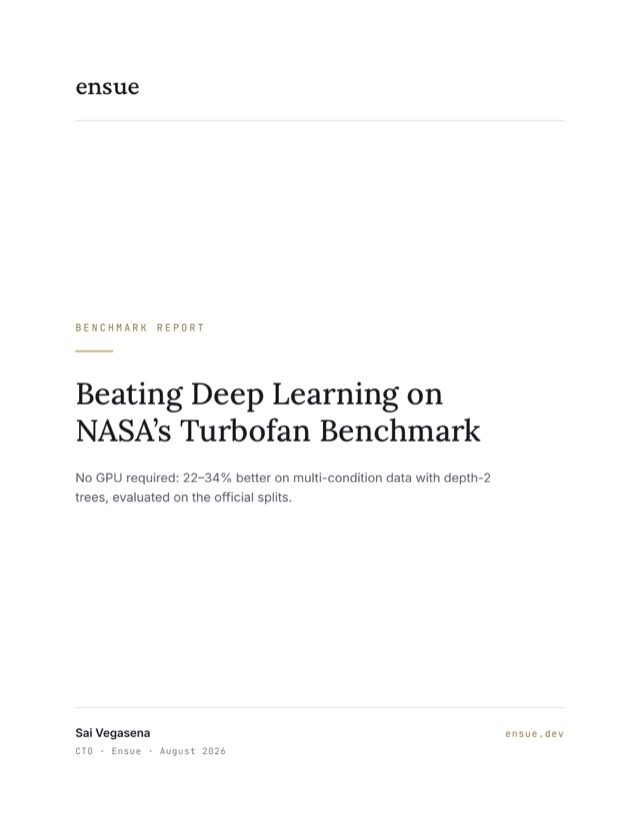
The turbofan RUL report, as a PDF.
You’ll also get the occasional research note from Ensue. No spam, ever.
Tell us the machine and the metric.
Bring the telemetry you already collect and the failure that costs you the most. We’ll scope the evaluation on the first call.