For medical imaging teams
Find the signal in the scan, and prove it’s real.
Research areas
The science we work on.
Weak-signal detection
Small cohorts and subtle effects, held to subject-level validation so a result survives more than one split.
Channel and feature attribution
Which spectral channels, depths, or regions actually carry the signal, ranked with the evidence behind each.
Confound control
Permutation nulls recomputed under the active selector, so selection capacity never inflates the score.
Validation that survives scrutiny
Pre-registration before held-out evaluation, falsifying ablations, bootstrap confidence intervals on every reported number.
Efficiency under deployment constraints
Models sized for the hardware in the clinic, not just the training cluster.
Traceability
The exact path behind every finding: what was tried, what failed, and every test run to break the result.
The engagement
How an engagement runs.
- 01
Your data never leaves
We stand up an air-gapped container in your VPC. Patient data stays inside it; only verified findings come out.
- 02
Define the metric and the bars
AUC, sensitivity at fixed specificity, whatever your protocol demands, plus the statistical bars a result must clear to count.
- 03
Pre-registered experiments at scale
Hundreds of experiments across channels, regions, and confounders, each pre-registered and then attacked with ablations.
- 04
Findings arrive with the full trail
A ranked signal map and a reproducible model, delivered as pull requests with the experiment evidence attached.
Proof
Verified, not vibes.
Take it with you
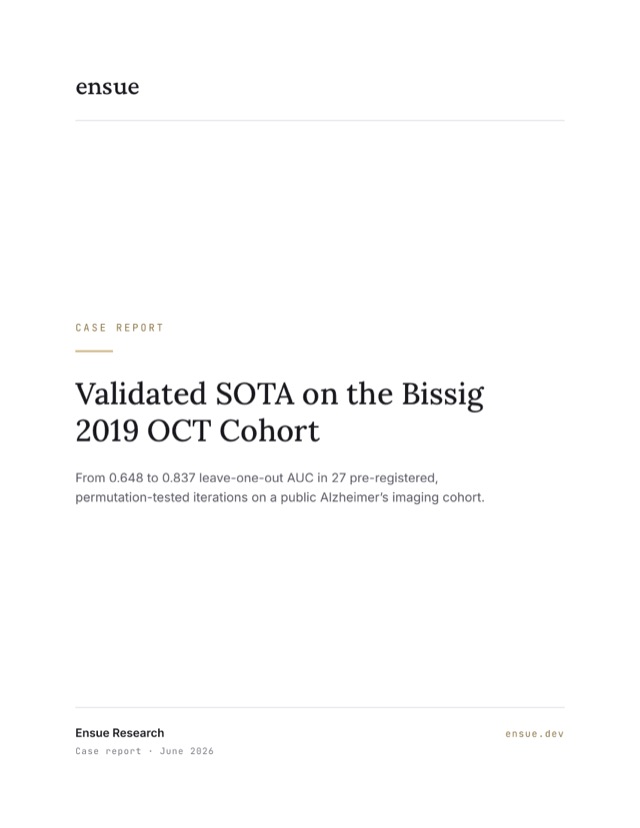
The OCT case report, as a PDF.
You’ll also get the occasional research note from Ensue. No spam, ever.
Bring us the number your imaging model is stuck on.
We prove capability on public data before we ever touch yours. Bring the metric that matters and we’ll scope the evaluation on the first call.